Part Worn Tyres – Are They Legal, Are They Safe, and Are They Worth It?
A part worn tyre can cost a fraction of what you’d pay for a new one. When you’ve found a nail through a sidewall a few days before payday, that difference can decide whether the car gets back on the road now or stays parked.
So here’s the straight answer. Part worn tyres are legal to buy and use, and a good one can be a sensible short-term purchase. But the rules governing their sale are strict, and Trading Standards investigations have repeatedly found tyres offered for sale that don’t meet them.
Knowing what you’re looking at matters.
What counts as a part worn tyre?
A part worn tyre is simply a tyre that has previously been fitted to another vehicle and is later removed and offered for sale for further use.
That doesn’t automatically mean there’s anything wrong with it. Anyone buying a second-hand car with its existing tyres is effectively driving on part worn tyres already.
Tyres are removed from vehicles for plenty of reasons. An owner might replace all four at once, change wheel sizes, fit a different tyre type or replace tyres before they’ve reached the legal tread limit.
Condition matters far more than the fact that the tyre has previously been used.
A tyre with around 3mm of tread may still have useful mileage remaining, but wet grip generally decreases as tread approaches the legal minimum. TyreSafe advises motorists to consider replacing tyres before they reach that limit.
Are part worn tyres legal in the UK?
Yes, but the legal guidance discussed here specifically covers England, Scotland and Wales.
The supply of part worn tyres in Great Britain is governed by The Motor Vehicle Tyres (Safety) Regulations 1994. The Regulations set minimum requirements covering the tyre’s tread, physical condition, markings and any repairs.
They regulate the supply of these tyres. A seller can’t simply remove a tyre from one vehicle, see some tread remaining and offer it for sale.
Business Companion, the Government-backed Trading Standards guidance service, also states that it is illegal for a business to have unsafe tyres in its possession for sale.
You can read the detailed requirements in the official Business Companion guidance on part worn tyres.
What makes a part worn tyre legal?
For a part worn tyre to be supplied legally, there are several requirements buyers should know about.
| Requirement | What the rules require |
| Tread depth | At least 2mm across the full breadth of the original tread pattern and around the tyre’s entire outer circumference |
| Marking | “PART-WORN” in uppercase letters at least 4mm high, permanently and legibly applied next to every approval mark |
| Approval marks | A non-retreaded tyre must carry the relevant ECE approval mark, such as E11, plus its speed and load capacity index moulded into the sidewall |
| Cuts | No external cut over 25mm or 10% of the tyre’s section width, whichever is greater, if deep enough to reach the ply or cord |
| Structure | No internal or external lump, bulge or tear caused by separation or partial structural failure |
| Cords | No ply or cord exposed internally or externally |
| Penetration damage | No penetration damage that hasn’t been repaired |
| Repairs | Any repair must comply with the relevant British Standard specified by the Regulations |
There is one detail worth explaining about repairs. The Regulations refer to BS AU 159f, while Business Companion notes that BS AU 159G is now the current Standard and recommends following the most up-to-date version.
Why does everyone talk about 1.6mm?
Because 2mm and 1.6mm apply at different stages.
A part worn car tyre being supplied for sale needs at least 2mm of original tread across its full breadth and around its entire circumference.
For most cars already being driven on the road, the normal legal tread requirement is 1.6mm across a continuous band covering the central three-quarters of the tread and around the entire circumference.
That 1.6mm requirement is also what motorists will commonly hear in relation to an MOT. You can see the measurement explained in TyreSafe’s tread depth guidance.
So a tyre shouldn’t be offered for sale as a part worn tyre simply because it has more than 1.6mm remaining. The supply standard requires 2mm.
The part nobody selling them wants to mention
Part worn tyres themselves are legal. Compliance across the wider market has been a different story.
In 2018, London Trading Standards and TyreSafe carried out Operation GRIP. Officers visited more than 150 businesses and then covertly purchased 51 part worn tyres for inspection.
The result was uncomfortable:
74% failed to meet legal safety standards.
Of those inspected, 33% showed serious safety failures, while a further 41% had marking issues.
A more recent investigation produced an equally striking result.
During a June 2025 multi-agency day of action in Preston, Lancashire County Council Trading Standards, TyreSafe and Lancashire Constabulary inspected 30 part worn tyres at three garages.
Not one of the 30 met the legal requirements.
Two had screws embedded in them. One had a serious structural defect. Another had a sidewall tear considered at risk of catastrophic failure. None of the 30 was correctly marked with the required PART-WORN wording.
Those findings are published by Lancashire County Council.
These inspections don’t mean every part worn tyre on sale is unsafe. They do show why buying one shouldn’t mean choosing whatever happens to be cheapest.
How to check a part worn tyre before you buy
You don’t need to be a tyre technician to spot some of the biggest warning signs.
1. Find the PART-WORN marking
Look for PART-WORN in uppercase letters at least 4mm high.
It should be permanently and legibly applied next to the tyre’s approval mark. The rules specifically exclude applying it by hot-branding or cutting the wording into the tyre.
No proper marking? Don’t ignore it.
2. Measure the tread properly
A tyre tread gauge is the best option because you need an actual measurement.
For supply as a part worn tyre, there should be at least 2mm across the full breadth of the original tread and around the complete circumference.
Check several points rather than measuring one healthy-looking groove in the centre.
The familiar 20p test is useful as a quick check against the normal 1.6mm in-use limit, but it isn’t precise enough to establish that a tyre satisfies the separate 2mm part worn supply requirement.
3. Inspect both sidewalls
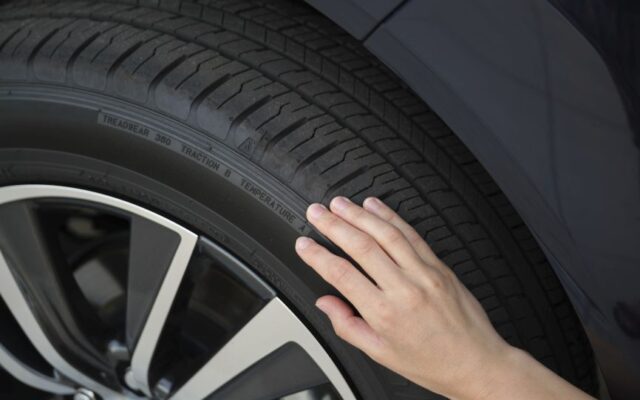
Look and feel around the complete tyre for cuts, cracking, lumps, bulges or distorted areas.
Don’t check only the outside wall that’s easy to see. The inner sidewall matters too. If the tyres are already fitted to a car, turning the front wheels can help you see more of the inner surface.
A lump or bulge can indicate damage to the tyre’s internal structure.
4. Find the date code
Tyres normally carry a four-digit manufacturing date code.
The first two digits identify the week and the final two identify the year. For example, 2422 means week 24 of 2022.
Age by itself doesn’t establish whether an ordinary passenger-car tyre is legal or illegal, but it gives you useful context when looking for cracking, perishing and deterioration.
Lancashire’s 2025 investigation found one nine-year-old tyre showing signs of perishing.
5. Check the load and speed ratings
Make sure the tyre is suitable for the vehicle.
Check the complete tyre size along with its load index and speed rating against the vehicle manufacturer’s specification. You’ll usually find the relevant information in the vehicle handbook, manufacturer documentation or tyre information for the vehicle.
Two tyres having the same wheel diameter doesn’t automatically make them interchangeable.
6. Ask whether it’s been inflation tested
Some problems become easier to identify when a tyre is inflated.
Business Companion recommends inspecting a part worn tyre before fitting and again after fitting and inflating it to its highest designed operating pressure. This is particularly important because some defects might not be visible while the tyre is deflated.
It’s a reasonable question to ask before handing over your money.
Not sure which tyre suits your car or your budget? Call and tell us what you drive, and we will talk you through what actually fits.
01737 771100How much do part worn tyres cost?
Part worn tyre prices vary heavily by wheel size, brand, tread remaining and availability.
Current advertised prices across UK independent sellers show smaller common sizes starting at roughly £15 to £30, with prices rising through £30, £40 and £50 as wheel sizes increase. Larger or less common sizes can cost £60 or more.
Those figures are only a general market guide. Fitting, balancing and valves may be included by one seller and charged separately by another.
Street Tyres sells part worn tyres from £10.
That low upfront cost is the main attraction. If the immediate problem is getting one damaged tyre replaced without spending significantly more on a new one, a part worn tyre can solve that problem.
Before deciding, check new tyre prices for your registration so you’re comparing the actual options available in your size.
Are they actually good value?
This is where purchase price stops telling the whole story.
Imagine a part worn tyre costs £30 and has 3mm of tread.
The normal in-use legal limit for a car tyre is 1.6mm, leaving about 1.4mm of tread before that limit.
TyreSafe says a tyre at 3mm may generally last somewhere between 10,000 and 20,000 miles, although actual mileage varies considerably. Using 14,000 miles purely as an illustrative estimate gives:
£30 ÷ 14,000 miles = about 0.21p per mile.
Now consider a new budget tyre costing £60.
New tyres commonly begin with roughly 7mm to 9mm of tread, depending on the tyre. That means considerably more tread is available before reaching 1.6mm.
You can’t reliably turn those extra millimetres into an exact mileage figure. Tread doesn’t wear at an identical rate on every tyre or every car. Alignment, pressure, driving style, tyre compound, vehicle weight and road conditions all affect how quickly it disappears.
But the comparison explains why a tyre costing twice as much upfront can still cost less for every mile of usable life.
A good part worn can make sense for a low-mileage second car, a vehicle that’s likely to be sold soon, or someone who needs an affordable roadworthy replacement now.
If you’re covering high annual mileage, a new budget tyre may give better long-term value and mean fewer tyre changes.
For more help comparing the options, see which budget tyre brands are worth buying new and how the tyre price tiers compare.
When we’d tell you not to buy one
Part worn isn’t automatically the best choice just because the initial bill is lower.
New drivers: starting with new tyres gives you their full tread depth and removes some of the uncertainty that comes with buying used tyres.
High-mileage motorway commuters: limited remaining tread can disappear relatively quickly if you’re covering hundreds of miles every week. Compare the longer-term cost before buying.
Anyone replacing all four tyres: four part worn tyres can turn a small saving per tyre into repeated replacement costs later. Compare the total against the tyre brands we stock new.
Anyone who can’t get straight answers from the seller: if the marking is wrong, tread can’t be properly measured, there’s suspicious damage or nobody can explain how the tyre was inspected, don’t buy it.
Cheap isn’t useful if you’re back buying another tyre shortly afterwards.
Part worn tyres in Redhill
Street Tyres sells part worn tyres from £10 from Holmethorpe Avenue in Redhill.
We also provide tyre fitting services for drivers in Redhill, Reigate, Horley and Merstham, including mobile fitting services across the local area.
If you need to check availability for your tyre size, get in touch.
You can also compare your options against a new tyre by entering your registration below:
Check prices Find the right tyres for your car Enter your registration for prices on tyres that fit. Fitting at our Redhill workshop or at your door.
That makes it easier to compare today’s lowest price with the likely longer-term value before deciding which option works for your car and mileage.
FAQs
Are part worn tyres legal in the UK?
Yes. Part worn tyres can legally be bought and used. In England, Scotland and Wales, their supply is governed by The Motor Vehicle Tyres (Safety) Regulations 1994. A tyre offered for sale must satisfy requirements covering its tread, condition, permanent PART-WORN markings and any repairs.
How much tread should a part worn tyre have?
A part worn tyre being supplied needs at least 2mm of original tread across its full breadth and around its entire circumference. Don’t confuse this with the normal 1.6mm in-use requirement for most car tyres, which applies across the central three-quarters of the tread.
How long do part worn tyres last?
There’s no fixed mileage. TyreSafe says tyres with around 3mm of tread may generally last 10,000 to 20,000 miles, but actual life varies widely with tyre type, pressure, alignment, road surface, vehicle weight, maintenance and driving style. Check the remaining tread rather than relying on an age or mileage promise.
Will part worn tyres pass an MOT?
Yes, a part worn tyre can pass an MOT. The MOT assesses the tyre fitted to the vehicle against requirements such as tread depth, condition, suitability and structural defects. A tyre doesn’t fail simply because it has previously been used. Its legality when originally supplied as a part worn tyre is a separate issue.
Are part worn tyres safe?
A previously used tyre isn’t automatically unsafe. Its actual condition is what matters. However, Trading Standards investigations have found high levels of non-compliance among tyres offered for sale, so buyers should check tread, markings, sidewall condition, age, ratings and inspection rather than choosing on price alone.
Tyres in Redhill, fitted in-store or at your door Street Tyres has been fitting tyres in Redhill since 2016, rated 4.8 from 392 Google reviews. Bring your car to our Holmethorpe Avenue centre, or we will come to you across Redhill, Reigate, Horley and Merstham.