Tyre Size Explained: How to Read the Numbers on Your Sidewall
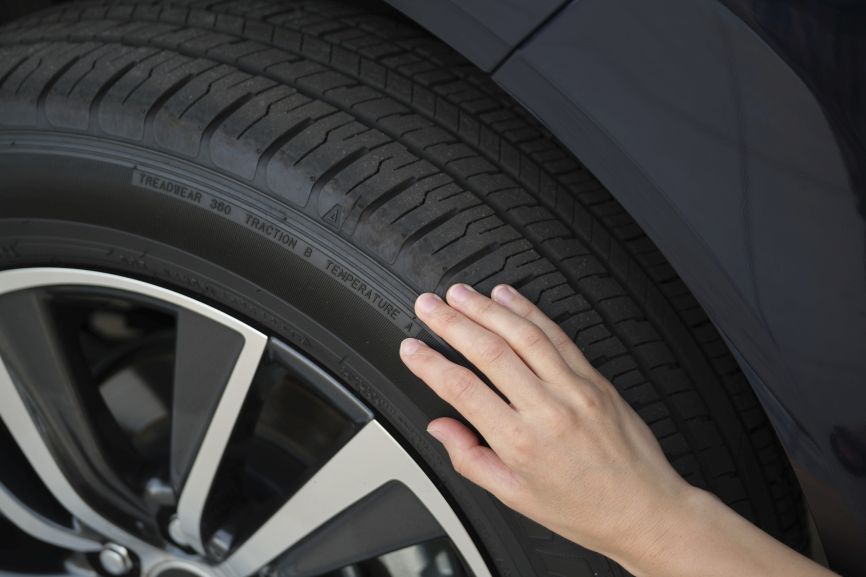
There are plenty of numbers, letters and symbols printed on the side of a tyre, but only a handful matter when you’re buying a replacement.
The code you want looks something like 205/55 R16 91V. It tells you the tyre’s width, profile, construction, rim size, load index and speed rating. Those details determine which tyres are suitable for the car. Brand, model and price come after that.
For a straightforward replacement, use this rule:
| What you’re checking | What to do |
| Width, profile and rim diameter | Use an approved size for that vehicle and wheel |
| Load index and speed rating | Meet or exceed the specified requirement |
| XL or run-flat construction | Follow the manufacturer’s specification |
| Brand, model and price | Your choice within suitable tyres |
Some cars have more than one approved tyre size, so changing size is possible. It just is not something to guess.
Where to find your tyre size
The easiest place to find your tyre size is the sidewall itself. Look for a code in the format 205/55 R16 91V. It is moulded into the rubber and is usually easier to spot than the smaller manufacturing and approval markings around it.
The second place is the vehicle information sticker, usually in the driver’s door shut, on the door pillar or inside the fuel flap. It often gives tyre pressures and may show approved sizes. Our guide to what the tyre pressure warning light is telling you explains what to check when the warning stays on.
The handbook is the third place to check, especially if the car had several wheel options.
There is also a faster option. If you have the registration number, you can look up tyres for your registration.
Check prices Find the right tyres for your car Enter your registration for prices on tyres that fit. Fitting at our Redhill workshop or at your door.
A registration search can identify tyre sizes that may fit your vehicle, but it is still worth checking what is actually fitted before ordering. Some models were supplied with different wheel options, and certain cars use different front and rear sizes.
Tyre size is separate from tyre condition. If you are checking remaining tread, see how tread depth is measured and when to replace.
Reading the sidewall, part by part
Use 205/55 R16 91V as the example.
| Part | What it means |
| 205 | Nominal tyre width in millimetres |
| 55 | Sidewall height as a percentage of tyre width |
| R | Radial construction |
| 16 | Wheel rim diameter in inches |
| 91 | Load index |
| V | Speed rating |
The first number, 205, is the nominal tyre width in millimetres.
The second number, 55, is the profile or aspect ratio. It does not mean the sidewall is 55 mm high. It means the sidewall height is 55% of the tyre’s width.
On a 205 mm tyre, 55% is about 113 mm. Put the same 55 profile on a 225 mm tyre and the sidewall is taller because the percentage is being taken from a larger width. That is why “low profile” is not one fixed measurement.
A lower profile generally means a shorter, stiffer sidewall, which can sharpen steering response but give a firmer ride and less protection from pothole or kerb impacts.
R means radial construction, used by the vast majority of modern passenger-car tyres.
The 16 is the diameter of the wheel rim the tyre fits, measured in inches. So the same code uses millimetres for width, a percentage for profile and inches for rim diameter.
Then comes 91V. The number is the load index and the letter is the speed rating.
Michelin’s guide to sidewall markings explains the same sizing format along with the other markings you may find on a tyre.
Load index: the number most people skip
The load index tells you the maximum load a tyre is designed to carry under its specified operating conditions. It is an index number, not a weight written directly in kilograms, so you need a lookup table.
In 205/55 R16 91V, the load index is 91. That corresponds to 615 kg per tyre.
| Load index | Maximum load per tyre |
| 80 | 450 kg |
| 84 | 500 kg |
| 88 | 560 kg |
| 91 | 615 kg |
| 94 | 670 kg |
| 97 | 730 kg |
| 100 | 800 kg |
| 103 | 875 kg |
| 105 | 925 kg |
| 109 | 1,030 kg |
The practical rule is to meet or exceed the load index required for the vehicle and that fitment. Going below the required capacity is not an acceptable shortcut.
A higher load index can be suitable, but it does not increase the vehicle’s legal carrying capacity. Axle and gross vehicle weight limits still apply.
Load capacity matters particularly on vans, heavier vehicles and some people carriers. Commercial-vehicle tyres can also use different markings, so a van tyre is not simply a larger passenger-car tyre.
For the underlying figures, TyreSafe on load and speed markings provides the relevant tables.
Speed rating, and why you don’t drop below it
The speed rating is the final letter in 205/55 R16 91V. It represents the tyre’s speed capability under specified test and load conditions. It is not a recommendation to drive at that speed, and it does not change the legal speed limit.
| Speed rating | Maximum rated speed |
| Q | 100 mph |
| R | 106 mph |
| S | 112 mph |
| T | 118 mph |
| U | 124 mph |
| H | 130 mph |
| V | 149 mph |
| W | 168 mph |
| Y | 186 mph |
| (Y) | Above 186 mph |
H looks out of place because it sits between U and V rather than where you would expect alphabetically.
For a normal replacement, use a speed rating that meets or exceeds the vehicle manufacturer’s requirement unless an approved alternative fitment says otherwise. The rating is not only about your own top speed. It also reflects the tyre’s construction and ability to manage heat under load.
Going above the required rating is normally fine where the tyre is otherwise suitable, but often unnecessary. If the car requires V, paying extra for W may give you no useful benefit on normal roads.
For W versus Y, W is rated to 168 mph and Y to 186 mph. A bracketed (Y) marking denotes a tyre approved for speeds above 186 mph under the tyre manufacturer’s specified conditions.
Fitting tyres below the vehicle manufacturer’s specification can also create insurance issues depending on the policy and circumstances, so check before buying anything outside the approved specification.
XL, run flats and the rest of the markings
XL means Extra Load. You may also see Reinforced or a similar marking.
An XL tyre has greater load-carrying capability than a standard-load tyre of the same nominal size. It does not mean you should simply add more air. Use the vehicle’s specified pressure. If the car requires XL tyres, do not replace them with standard-load versions just because the basic size matches.
M+S means Mud and Snow, but it is not the same as the three-peak mountain snowflake, or 3PMSF, symbol. M+S is a classification marking, while a 3PMSF tyre has met a defined snow-performance test. Our guide to how all season tyres work in the UK explains where these markings fit, while our winter guide covers whether winter tyres are worth it here.
Run-flat markings vary by manufacturer, including RFT, ROF, ZP, SSR, DSST and EMT. They allow limited driving after pressure loss, and cars designed around them often have no conventional spare.
Whether a punctured run-flat can be repaired depends on the manufacturer, damage location, use while deflated and internal inspection. See when a puncture can be repaired and when it can’t for more detail.
A four-digit date code shows the manufacturing week and year, so 2425 means week 24 of 2025. Age alone does not determine a tyre’s condition.
Directional tyres use an arrow for rotation direction, while asymmetric tyres are marked inside and outside. These are fitting instructions, not tyre sizes.
Not sure whether your car needs run flats, XL tyres or a particular speed rating? Give us the registration over the phone and we’ll tell you exactly what fits.
Which parts must match, and which are up to you
For a like-for-like replacement, use a manufacturer-approved width, profile and rim diameter for the vehicle and wheel combination.
If the approved fitment is 205/55 R16, do not casually change one of those numbers because another tyre is cheaper or happens to be in stock.
Next, meet or exceed the required load index and speed rating. In our example of 205/55 R16 91V, that means paying attention to the 91V as well as the more obvious 205/55 R16.
Then check whether the car or approved fitment requires features such as XL construction or run-flat technology. Two tyres can have the same basic dimensions while having different load capabilities or construction.
Once those requirements are settled, brand and tyre model become your choice, based on factors such as wet grip, comfort, mileage, noise and price.
If you are comparing manufacturers, start with how tyre brands are tiered, then look at what you actually get moving up the price tiers. If keeping the cost down is the priority, we have also covered the budget brands worth buying.
The tyre has to be suitable for the car first. Brand and price come second.
When the sidewall and the door sticker don’t match
The tyre sidewall tells you what is fitted now. The vehicle sticker and handbook tell you what the manufacturer specified or approved.
Those are not always the same.
On a used car, a previous owner may have changed the wheels, chosen another approved fitment or fitted the wrong size.
If the sidewall and vehicle information disagree, do not assume the current tyre must be right simply because it is already on the car. Start with the manufacturer’s information and find out why the current size differs before ordering another set to match it.
There is also an MOT consideration. The current DVSA MOT inspection manual treats different tyre sizes on the same axle as a major defect, subject to the specific exceptions in the manual.
The manual’s explicit load-rating and speed-rating inspection requirements apply to Classes 5 and 7, so they should not be treated as a blanket MOT check of those ratings on every ordinary passenger car.
Can you fit a different size?
Yes. Many cars have more than one tyre and wheel size approved by the manufacturer. That does not mean you can fit any size that physically fits under the wheel arch.
Changing width, profile or wheel diameter can affect rolling circumference, speedometer accuracy, steering response and clearance around suspension, brakes and bodywork.
Moving to a different wheel diameter also means using the corresponding approved tyre and wheel combination rather than changing one number in isolation.
For a non-standard combination, check approved fitments and your insurer first because notification requirements depend on the policy.
Getting the right size fitted in Redhill
Street Tyres can check the tyre size, load index, speed rating and other relevant markings before helping you choose between suitable budget, mid-range and premium options.
If you are unsure what you are looking at, reading the code from the tyre or giving us the registration is usually enough to get started.
You can visit Street Tyres at Holmethorpe Avenue in Redhill, or use the mobile tyre-fitting service across Redhill, Reigate, Horley and Merstham.
If you want to check a size, ask about availability or arrange fitting, get in touch.
FAQs
How do I find my tyre size?
Look on the tyre sidewall for a code such as 205/55 R16 91V. You can also check the vehicle information sticker or handbook. A registration lookup is quicker, but confirm the actual front and rear tyre sizes before ordering because some vehicles have more than one approved fitment.
Can I find my tyre size from my registration?
Yes. A registration lookup can identify tyre sizes that may fit your vehicle. It is a useful shortcut, but you should still check the tyres on the car before ordering because wheel options can vary and some vehicles use different sizes at the front and rear.
What do the numbers on my tyres mean?
In 205/55 R16 91V, 205 is the tyre width in millimetres, 55 is the sidewall height as a percentage of the width, R means radial construction, 16 is the rim diameter in inches, 91 is the load index and V is the speed rating.
Can I fit a different size tyre to my car?
Yes, if it is a manufacturer-approved alternative or a properly assessed replacement fitment. Changing tyre dimensions can affect rolling circumference, speedometer accuracy, clearance and handling. Check approved sizes before buying rather than assuming a similar-looking tyre will work.
What does XL mean on a tyre?
XL means Extra Load. An XL tyre has greater load-carrying capability than a standard-load tyre of the same nominal dimensions. If your vehicle requires XL tyres, do not replace them with standard-load versions simply because the width, profile and rim diameter are the same.
What’s the difference between a W and a Y speed rating?
A W-rated tyre has a maximum rated speed of 168 mph, while a Y-rated tyre is rated to 186 mph. A bracketed (Y) marking is used for tyres approved above 186 mph under specified conditions. For normal replacements, use a rating that meets or exceeds the manufacturer’s requirement.
Tyres in Redhill, fitted in-store or at your door Street Tyres has been fitting tyres in Redhill since 2016, rated 4.8 from 392 Google reviews. Bring your car to our Holmethorpe Avenue centre, or we will come to you across Redhill, Reigate, Horley and Merstham.