Is Wheel Alignment the Same as Tracking?
Ring three garages about a car that’s pulling to the left and you may hear three different terms. Tracking. Wheel alignment. Four-wheel alignment. Somebody might mention balancing as well.
They’re related, but they’re not all the same job. Tracking usually means checking and adjusting wheel toe, most commonly at the front. Full wheel alignment can measure more of the vehicle’s geometry and may involve all four wheels. Balancing is completely different: it corrects uneven weight around a wheel and tyre assembly.
Here’s how to work out what your car actually needs.
The short answer
Tracking is generally treated as part of wheel alignment rather than a completely separate process.
Traditionally, tracking refers to checking and adjusting toe, particularly on the front wheels. A more comprehensive alignment check can measure toe, camber and caster, along with the relationship between the front and rear wheels.
The confusion comes from the fact that garages don’t all use these terms in exactly the same way. One workshop’s “tracking” may be another workshop’s “front-wheel alignment”.
Wheel balancing is different again. It deals with weight distribution around the rotating wheel and tyre, not wheel angles.
What “tracking” usually means
Tracking normally refers to the toe setting of the wheels.
Imagine looking down at your car from directly above. If the fronts of the wheels point slightly towards each other, that’s toe-in. If they point away from each other, that’s toe-out.
The vehicle manufacturer specifies the correct setting. Too much toe in either direction can make the tyres scrub sideways against the road rather than rolling as intended. Over time, that can cause rapid or feathered tread wear.
Toe can move away from specification after impacts with potholes or kerbs. Wear in suspension or steering components can also affect wheel geometry.
Because front toe is commonly checked and is adjustable on many cars, it’s the alignment job a lot of drivers know simply as “tracking”.
What full wheel alignment covers
A fuller alignment check can look beyond front-wheel toe. The three terms you’re most likely to hear are toe, camber and caster.
Toe
Toe describes whether the wheels point slightly inward or outward when viewed from above.
Incorrect toe can make the tread blocks scrub sideways as the tyre rolls. One possible result is feathered wear, where the tread blocks feel smoother along one edge and sharper along the other.
Camber
Camber is the inward or outward tilt of the wheel when you look at the vehicle from the front.
If the top of the wheel leans towards the vehicle, that’s negative camber. If it leans away, that’s positive camber. Excessive camber can place more load on one shoulder of the tyre and contribute to uneven wear.
Caster
Caster describes the angle of the steering axis when viewed from the side.
It affects steering stability, steering feel and the tendency of the steering to return towards the straight-ahead position after a turn.
You can see the same wheel-geometry principles explained in Michelin’s wheel alignment and balancing guide.
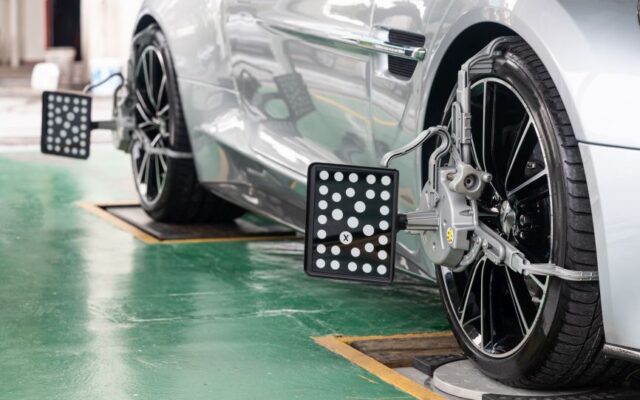
A four-wheel alignment measures the rear wheels as well as the fronts. That matters because the rear-wheel geometry affects the direction the vehicle travels. If the rear geometry is out, the car can behave oddly even if the front settings appear correct.
There’s an important distinction here: measuring an angle doesn’t necessarily mean that angle can be adjusted.
On many ordinary cars, toe is the main factory-adjustable alignment setting. Camber and caster may be fixed by the suspension design unless the manufacturer provides adjustment or suitable adjustable components have been fitted.
So if a garage measures toe, camber and caster but can only correct the toe on your car, that isn’t automatically a problem. What can actually be adjusted depends on the vehicle’s suspension design.
Where the terminology gets muddled
There isn’t a strict industry-wide definition of “tracking” that every garage follows.
Some workshops use tracking and wheel alignment almost interchangeably. Others use tracking for a front-toe check and adjustment, while “wheel alignment” means a broader geometry measurement.
Even “four-wheel alignment” can cause confusion. A garage may measure all four wheels but find that only certain settings can be adjusted on that particular vehicle.
The useful question, then, isn’t what the service is called. Ask what’s actually included.
If you’re comparing services, ask:
- Which wheels and angles will be measured?
- Which settings can be adjusted on my car?
Those answers tell you much more than whether the invoice says “tracking”, “alignment” or “four-wheel alignment”.
Seen something on your tyre you are not sure about? Bring it in and we will take a look - we would rather tell you it is fine than have you drive on it wondering.
01737 771100What wheel balancing is, and why it isn’t alignment
Wheel balancing is a different job.
Even a correctly manufactured wheel and tyre assembly can have small variations in weight around it. Once the wheel is spinning at speed, an imbalance may produce noticeable vibration.
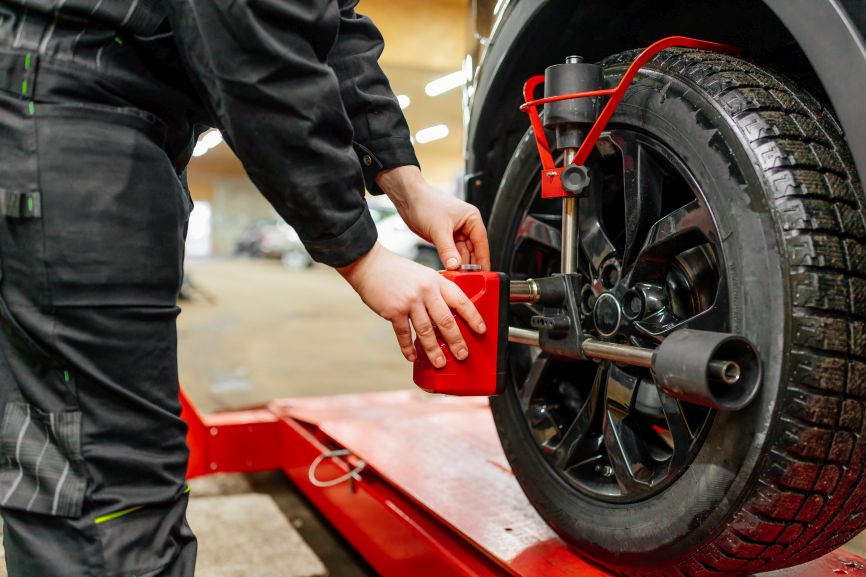
A balancing machine spins the wheel and identifies where weight needs to be added. Small balancing weights are then fitted to compensate.
| Alignment / tracking | Balancing | |
| What it fixes | The angles and direction the wheels sit at | Uneven weight around the wheel and tyre |
| Typical symptom | Uneven tyre wear, off-centre steering or pulling | Vibration through the steering wheel or vehicle, often at speed |
| When it’s needed | After impacts, uneven wear or steering complaints | When fitting tyres or investigating vibration |
| Done with | Wheel alignment equipment | Wheel balancing machine |
Balancing is normally part of fitting a tyre to a wheel. Alignment isn’t automatically carried out every time tyres are replaced, although worn tyres with an unusual wear pattern are a good reason to check the vehicle’s geometry before the new set suffers the same fate.
How to tell which one you need
The symptoms can point you in the right direction, although they aren’t a substitute for inspecting the car.
- Car pulls consistently to one side on a reasonably flat road → alignment is one possibility.
- Steering wheel sits off-centre while travelling straight → have the alignment checked.
- One shoulder of a tyre is wearing faster → check alignment, pressures and suspension condition.
- Tread blocks feel feathered or scrubbed → incorrect toe may be involved.
- Steering wheel vibrates at certain road speeds → wheel imbalance is one possible cause.
- Vibration is felt strongly through the seat or vehicle body → rear-wheel imbalance may be involved.
- You’ve hit a pothole or kerb hard → an alignment check is sensible.
It’s important not to diagnose alignment from one symptom alone.
A car can pull because of incorrect tyre pressures, tyre differences, road camber, suspension problems or a dragging brake. Vibration can also come from a damaged tyre, buckled wheel or worn suspension component.
A vehicle can need both alignment and balancing, particularly if the tyres have been replaced and the geometry was already out.
When checking uneven wear, look at the rest of the tyre as well. TyreSafe confirms that car tyres in the UK need at least 1.6mm of tread across the central three-quarters of the tread around the entire circumference.
Also check for deterioration elsewhere on the tyre. Our guide explains how to tell harmless tyre cracking from the dangerous kind.
When to get alignment checked
For most drivers, alignment is better treated as a condition-led check than something that has to be done on an arbitrary fixed schedule.
Consider having it checked if:
- you hit a substantial pothole or kerb
- the steering wheel no longer sits straight
- the vehicle starts pulling to one side
- you notice uneven or unusual tyre wear
- the steering behaviour changes
- you’re replacing tyres that have worn unevenly
New tyres are also a sensible opportunity to check alignment where there’s evidence that the old set hasn’t worn evenly.
Don’t ignore shoulder wear simply because there’s plenty of tread left in the centre. If one edge is disappearing much faster than the rest, find out why before the tyre suffers further wear.
Our guide to what outside-edge tyre wear is telling you covers the possible causes in more detail, including alignment, tyre pressures and driving conditions.
Does alignment save you money?
Correct wheel geometry helps your tyres roll and wear as intended. If incorrect toe is causing the tread to scrub against the road, usable rubber can wear away unnecessarily quickly.
Correcting the geometry can stop that abnormal wear from continuing.
What alignment can’t do is restore tread that has already disappeared. If a tyre shoulder is badly worn, correcting the alignment may protect the replacement tyre, but it won’t repair the existing one.
Tyre quality, vehicle type, driving style, pressures and road conditions still affect how long a tyre lasts. Alignment doesn’t make every tyre perform or wear identically.
If you’re weighing up replacement options, our guide explains what the different tyre price tiers actually get you.
You can also check tyre prices for your registration before choosing replacements.
Wheel alignment in Redhill
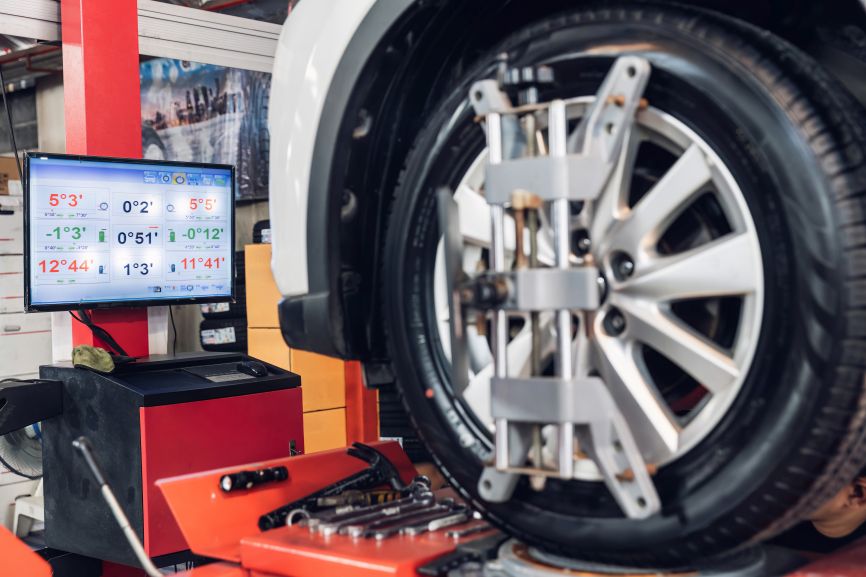
Wheel alignment requires workshop equipment to measure the vehicle’s geometry accurately, so the car needs to come to the Street Tyres workshop on Holmethorpe Avenue.
If the steering wheel has moved off-centre, the car has started pulling or you’ve found unusual tyre wear, get in touch and describe what the vehicle is doing.
Street Tyres also offers mobile tyre fitting across Redhill, Reigate, Horley and Merstham. Wheel alignment itself, however, is a workshop service and isn’t carried out through the mobile fitting service.
Check prices Find the right tyres for your car Enter your registration for prices on tyres that fit. Fitting at our Redhill workshop or at your door.
FAQs
Is tracking the same as wheel alignment?
They overlap, but the terminology varies between garages. Tracking usually refers to checking and adjusting toe, commonly on the front wheels. Wheel alignment can mean a broader geometry check covering additional angles and the relationship between the front and rear wheels. Ask what will actually be measured and adjusted.
Do I need two-wheel or four-wheel alignment?
It depends on the vehicle and the symptoms. Measuring all four wheels can show how the rear geometry relates to the fronts and the vehicle centreline. However, not every measured angle will necessarily be adjustable. The available adjustments depend on the suspension design and manufacturer specifications.
Is wheel balancing the same as alignment?
No. Alignment deals with wheel and suspension geometry. Balancing corrects uneven weight around a rotating wheel and tyre assembly. Alignment problems commonly show up as uneven wear or steering issues, while imbalance is more commonly associated with vibration, particularly at certain road speeds.
How often should wheel alignment be checked?
There’s no single interval that suits every car and driver. Have the alignment checked when you notice uneven tyre wear, persistent pulling, an off-centre steering wheel or a change in steering behaviour. A significant pothole or kerb impact is another good reason to have the geometry inspected.
Can bad alignment damage tyres?
Yes. Incorrect alignment can cause parts of the tread to scrub or carry more load than intended, leading to feathering or excessive shoulder wear. Correcting the alignment can prevent further abnormal wear, but it can’t restore tread that has already been worn away.
Tracking, alignment and balancing are easy to mix up because garages don’t always use the words in exactly the same way. Rather than focusing on the label, ask what will be measured, what can be adjusted and whether the symptoms point towards alignment, balancing or another mechanical problem.
If your steering isn’t sitting straight or your tyres are wearing unevenly, getting the cause checked early can prevent unnecessary tyre wear.
Tyres in Redhill, fitted in-store or at your door Street Tyres has been fitting tyres in Redhill since 2016, rated 4.8 from 392 Google reviews. Bring your car to our Holmethorpe Avenue centre, or we will come to you across Redhill, Reigate, Horley and Merstham.