
Tyre Tread Depth – The UK Legal Limit and When to Actually Replace
Most drivers know there’s a legal minimum for tyre tread. Fewer know exactly where that 1.6mm has to be measured, and fewer still realise that a tyre can remain technically legal while its wet-weather performance has already deteriorated badly.
For cars and most light vans, the UK minimum is 1.6mm across the central three-quarters of the tread, around the entire circumference. But tyre safety experts generally recommend thinking about replacement at around 3mm, particularly if you do plenty of motorway driving or expect wet winter conditions.
Here’s what the law actually measures, how to check your tyres properly, and what 2mm, 3mm, 4mm or 5mm of remaining tread really tells you about how much life is left.
What the law actually says
For most cars and light vans used on UK roads, the legal minimum tread depth is 1.6mm.
Under Regulation 27 of the Road Vehicles (Construction and Use) Regulations 1986, the primary grooves of the tyre must have at least 1.6mm of tread:
- throughout the central three-quarters of the breadth of the tread
- around the tyre’s entire circumference
“Primary grooves” matters here. They’re essentially the main grooves originally moulded to the same depth as those containing the tread wear indicators. Small secondary grooves and sipes aren’t necessarily part of the legal tread-depth measurement.
The central three-quarters rule also causes confusion.
Imagine the usable tread width divided into four equal sections. The law requires sufficient depth across the middle three of those four sections. The outer shoulders sit outside that measured area.
That means a tyre with heavy shoulder wear isn’t automatically below the legal tread-depth requirement purely because the very edge measures less than 1.6mm. There may still be other reasons why the tyre is unsafe or fails an MOT, such as exposed cords, structural damage or severe deterioration.
We’ve explained why worn shoulders don’t always make a tyre illegal in more detail separately.
Different classes of vehicle can have different tread requirements. Some vehicles, including certain larger passenger vehicles and motorcycles, use a 1.0mm requirement rather than 1.6mm, alongside rules about maintaining a visible tread pattern.
There’s another number worth knowing if you’re buying used tyres. A part-worn tyre offered for sale has additional legal requirements and must generally have at least 2mm of tread across the full breadth of the tread when supplied. You can read the separate rules covering part worn tyres before buying one.
What are the penalties for illegal tyre tread?
Driving on tyres below the legal tread requirement can become very expensive very quickly.
The maximum penalty is up to £2,500 and three penalty points per illegal tyre.
If all four tyres were prosecuted separately, that means a theoretical maximum of:
- £10,000 in fines
- 12 penalty points
For most drivers, accumulating 12 points can lead to disqualification under the normal totting-up rules, although the outcome depends on the individual case and licence circumstances.
There can also be insurance consequences.
Motor insurance policies commonly require the vehicle to be kept in a roadworthy condition. An insurer can therefore question or dispute a claim where illegal or unroadworthy tyres contributed to a collision, depending on the circumstances and the wording of the policy.
That doesn’t mean one worn tyre automatically “invalidates your insurance”. Claims are more complicated than that. But driving a knowingly unroadworthy vehicle creates a problem you don’t want to be explaining after an accident.
Why 3mm matters more than 1.6mm
The 1.6mm figure answers a legal question.
It doesn’t tell you the point at which a tyre still performs as well as you’d like in heavy rain.
Tyre tread has several jobs, but one of the most important is clearing water from underneath the contact patch. As the grooves become shallower, the tyre has less capacity to move that water away.
Wet grip suffers. The risk of aquaplaning rises. Braking distances increase.
This is why TyreSafe recommends considering replacement at around 3mm rather than deliberately running tyres all the way down to 1.6mm.
There are useful test figures behind that advice.
MIRA testing cited by TyreSafe found that cars running tyres at 1.6mm could have up to 44% longer braking distances in wet conditions than cars running tyres at 3mm.
Separate Continental testing cited by TyreSafe compared braking from 50mph in the wet. Against a new tyre with around 8mm of tread:
- tyres at 3mm took about 2.7 metres further to stop
- tyres at 1.6mm took about 6.9 metres further to stop
Exact results will change with the tyre, car, water depth, temperature, road surface and test conditions. That’s why a single stopping-distance number should never be treated as universal.
The pattern is what matters: wet-weather performance deteriorates substantially as tread approaches the legal minimum.
A tyre doesn’t suddenly become bad at 1.59mm and perfectly capable at 1.61mm. The legal line has to exist somewhere, but grip has already been declining before you cross it.
How much tread do new tyres have?
A new passenger-car tyre will commonly have roughly 7mm to 9mm of tread, with around 8mm often used as a convenient rule of thumb.
It isn’t a fixed manufacturing standard.
The starting depth varies between tyre models and manufacturers. Winter and some all-season tyres can use deeper tread patterns, while particular performance or efficiency-focused tyres may begin with something different.
That starting point matters when you’re estimating remaining life.
An 8mm tyre isn’t “half worn” at 4mm in terms of usable legal tread. If you plan to replace at 3mm, its usable range is roughly 8mm down to 3mm. If you intend to continue to the legal minimum, the range extends to 1.6mm.
Mileage doesn’t divide neatly by millimetres either.
How long will your tyre tread last?
This is where confident online answers become misleading.
Someone will tell you that 1mm equals 5,000 miles. Someone else will say 10,000. Neither figure can tell you how quickly the tyres on your own car will wear.
Tyre wear depends on:
- how hard you accelerate and brake
- motorway versus urban driving
- road surface
- tyre pressure
- wheel alignment
- suspension condition
- vehicle weight
- driven axle
- tyre compound
- temperature
- how heavily the car is loaded
Even the front and rear tyres on the same car may wear at very different rates.
Tread depth chart: what your measurement means
| Current tread | Rough position in its usable life | What we’d suggest |
| 8mm | Typical new-tyre territory | Nothing to do beyond routine checks |
| 5mm | Comfortable tread remaining | Check every few months |
| 4mm | Clearly worn but still with a useful margin | Start monitoring more regularly |
| 3mm | Wet performance becoming the bigger concern | Budget and plan for replacement |
| 2mm | Very close to the 1.6mm legal minimum | Replace soon rather than trying to squeeze out every mile |
| 1.6mm | Legal minimum reached | Replace now; below this is illegal |
How long will 5mm of tyre tread last?
At 5mm, most tyres still have a useful amount of tread available, but there’s no responsible way to convert that into one mileage figure.
If the tyre began around 8mm, roughly 3mm has already worn away. Look at how many miles the car travelled while losing those 3mm and you’ll have a much better clue than a national average.
A car doing gentle motorway mileage on correctly inflated, well-aligned tyres may wear tread much more slowly than a heavy vehicle doing short urban trips with frequent braking.
How long will 4mm of tyre tread last?
At 4mm, it’s sensible to start watching the trend rather than worrying about an exact replacement date.
If you cover low annual mileage, 4mm could represent plenty of calendar time. If you’re about to drive several thousand miles through a wet winter, you’ll want to monitor it far more closely.
This is also the point where uneven wear starts to matter enormously. A centre reading of 4mm isn’t much comfort if another primary groove elsewhere around the tyre is considerably lower.
How long will 3mm of tyre tread last?
There may still be thousands of miles of physical tread life between 3mm and 1.6mm, but that doesn’t mean you should automatically use every last fraction of it.
Published estimates for tread wear vary widely. Depending on the vehicle, tyre and use, losing one millimetre can take several thousand miles.
At 3mm, the better question isn’t “How many miles until this becomes illegal?”
It’s “What conditions will I be driving in during those miles?”
If winter is approaching, you regularly drive at motorway speeds, or you cover high monthly mileage, replacement at around 3mm becomes easier to justify.
How long will 2mm of tyre tread last?
Not long enough to gamble on an average.
At 2mm, you have only 0.4mm above the legal minimum for a normal car tyre. Wear isn’t always perfectly even, so one part of the tyre could cross the limit before the point you happened to measure.
If your tyre is at 2mm, arrange replacement soon rather than trying to calculate exactly how many journeys you can get out of it.
The best way to estimate your own wear rate
Measure the tyres today.
Record the depth and the car’s mileage.
Measure the same grooves again in roughly three months.
If, for example, a tyre has lost 0.5mm during the distance you’ve covered, you now have a real wear rate for your car, your tyre and your driving.
Keep in mind that future wear may not remain perfectly linear, but your own measurements are far more useful than somebody else’s blanket “miles per millimetre” figure.
Should you change tyres at 3mm?
Legally, you don’t have to replace an otherwise roadworthy car tyre simply because it has reached 3mm.
Practically, there’s a strong case for starting replacement at that point.
Consider changing at around 3mm if:
- autumn or winter is approaching
- you regularly drive in heavy rain
- you do a lot of motorway mileage
- your monthly mileage is high enough that 3mm could become 2mm quickly
- the tyre is also ageing, cracking or wearing unevenly
If you drive very little and your tyres are wearing evenly, you may choose to keep monitoring them for longer. Just don’t treat 1.6mm as a target.
And if replacement cost is part of the decision, it helps to understand what the different tyre price tiers actually get you rather than assuming the most expensive option is automatically necessary.
You can also check replacement prices for your registration before the tyre reaches the point where replacement becomes urgent.
Not sure whether yours have enough left for the winter? Bring the car in and we’ll measure all four properly – takes a couple of minutes and there’s no charge for looking.
01737 771100How to check your tyre tread depth
You don’t need specialist workshop equipment to keep an eye on tread. There are three useful methods.
1. Use a tread depth gauge
A tread depth gauge is the best option for an actual measurement.
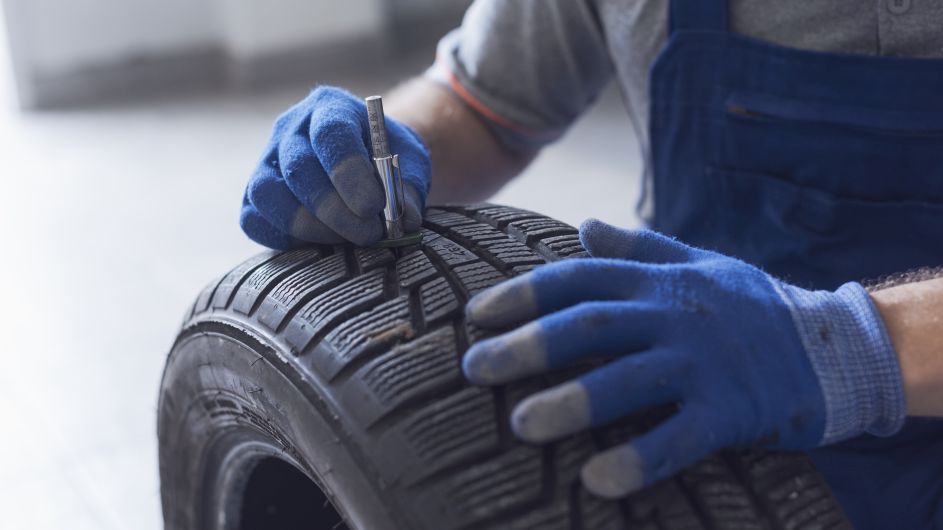
Place the probe into one of the main tread grooves and keep the base of the gauge flat against the tread block. Read the depth, then repeat the measurement.
Don’t check one groove in one location and call it done.
Measure:
- several primary grooves across the tyre
- several points around the circumference
- all four tyres
This is how you find uneven wear that one convenient measurement could miss.
2. Look at the tread wear indicators
Tyres have small raised bars moulded into their primary grooves.
These tread wear indicators are positioned at the legal wear level, typically 1.6mm on passenger-car tyres.
As the surrounding tread wears down, it gets progressively closer to the top of the bar. When the tread surface becomes flush with the indicator, the tyre has reached the minimum.
They’re useful for spotting a tyre nearing the limit, but a gauge gives you much more information when you’re trying to decide between, say, 3mm and 2.5mm.
3. Use the 20p test
No gauge available? A 20p coin gives you a quick indication.
Insert the coin vertically into one of the main tread grooves.
If the outer band around the edge of the coin disappears into the tread, the tyre is likely still above the legal minimum in that location.
If you can clearly see the outer band, the tread may be too low and needs checking properly.
The key word is may.
The 20p test is a screening check, not a precise tread-depth measurement. Don’t use the width of the coin’s border to claim an exact millimetre reading.
And again, repeat the test at several points around each tyre. One good-looking section doesn’t prove the whole circumference is legal.
Will low tyre tread fail an MOT?
Yes.
For a normal car subject to the 1.6mm requirement, insufficient tread in the relevant primary grooves across the central three-quarters and around the circumference is an MOT failure.
The current DVSA MOT inspection manual treats tread depth below the required standard as a tyre defect.
But tread depth is only one part of tyre condition.
A tyre can have 5mm of tread and still be unroadworthy because of structural damage, exposed cords, a serious bulge or another defect.
Age-related deterioration matters too. If you’re seeing splits or weathering, here’s how to tell harmless tyre cracking from the dangerous kind.
An MOT certificate also isn’t a guarantee that your tyres will remain legal until the next test. You’re responsible for keeping the vehicle roadworthy between MOTs.
What makes tyres wear faster?
Two supposedly identical tyres can reach 3mm at very different mileages.
A few factors make the biggest difference.
Incorrect pressure: Underinflation tends to increase wear towards the shoulders, while overinflation can concentrate wear more heavily through the centre.
Wheel alignment: Incorrect toe, camber or other geometry can rapidly wear one section of the tyre. If those terms are getting mixed together, here’s the difference between tracking, alignment and balancing.
Hard acceleration and braking: Repeatedly asking the tyres to transmit large forces into the road increases wear.
Vehicle weight and loads: A heavily loaded vehicle places more stress on its tyres, particularly if pressures haven’t been adjusted correctly for the load.
Tyre construction and compound: Different tyres prioritise grip, longevity, efficiency, comfort and performance differently. Two legal tyres on the same car don’t necessarily wear at identical rates.
If tread is disappearing much faster on one tyre or one edge, find the cause rather than repeatedly replacing rubber.
Getting your tread checked in Redhill
If you’re unsure what your measurements mean, Street Tyres can check the tread across all four tyres and look for obvious uneven wear or tyre damage.
You can visit us at Holmethorpe Avenue in Redhill, or arrange mobile tyre fitting across Redhill, Reigate, Horley and Merstham.
If replacement is needed, the important thing is choosing the correct tyre for the car and replacing it before a marginal tread reading becomes an illegal one.
You can get in touch if you’d like the tyres checked.
Check prices Find the right tyres for your car Enter your registration for prices on tyres that fit. Fitting at our Redhill workshop or at your door.
FAQs
What is the legal tyre tread depth in the UK?
For most cars and light vans, the legal minimum is 1.6mm in the primary tread grooves across the central three-quarters of the tread width and around the entire circumference. Other vehicle classes can have different requirements, so the 1.6mm rule shouldn’t be applied to every vehicle automatically.
Should I replace tyres at 3mm or 1.6mm?
You don’t legally have to replace a normal car tyre at 3mm purely because of tread depth. However, wet grip deteriorates as tread wears, and TyreSafe advises considering replacement around 3mm. At 1.6mm you’ve reached the legal minimum, leaving no useful margin for further wear.
How long will 3mm of tyre tread last?
There’s no reliable universal mileage. Wear depends on the tyre, car, alignment, pressures, driving style, road surface and mileage pattern. Measure the tyre now and again after a known distance. Your own wear rate gives a much better estimate than assuming every millimetre lasts a fixed number of miles.
How much tread do new tyres have?
New passenger-car tyres commonly start with roughly 7mm to 9mm of tread, with around 8mm often used as a general benchmark. Exact new tyre tread depth varies between manufacturers, models and tyre types, so don’t assume every brand-new tyre starts with precisely the same depth.
How do I check tyre tread without a gauge?
Use the 20p test as a quick indicator. Insert a 20p coin into several main grooves around the tyre. If the coin’s outer band is visible, the tread may be low and should be measured properly. The coin test doesn’t provide an exact millimetre reading.
Can you get points for illegal tyres?
Yes. Driving with an illegal tyre can result in up to three penalty points and a fine of up to £2,500 per tyre. Multiple illegal tyres can therefore lead to multiple penalties. Keeping an eye on tread before it reaches 1.6mm is much easier than dealing with the consequences afterwards.
Tyres in Redhill, fitted in-store or at your door Street Tyres has been fitting tyres in Redhill since 2016, rated 4.8 from 392 Google reviews. Bring your car to our Holmethorpe Avenue centre, or we will come to you across Redhill, Reigate, Horley and Merstham.